
In development
All of it in one place, in the participant's name.
Every service keeps its own file, and none of them add up — not for the person they're about, and not for the people supporting them. CDS turns that around: the participant holds their own account, their whole team contributes to one shared profile, and they choose who connects.
- Built and hosted in Australia
- WCAG 2.1 AA
- Access granted and withdrawn by the participant
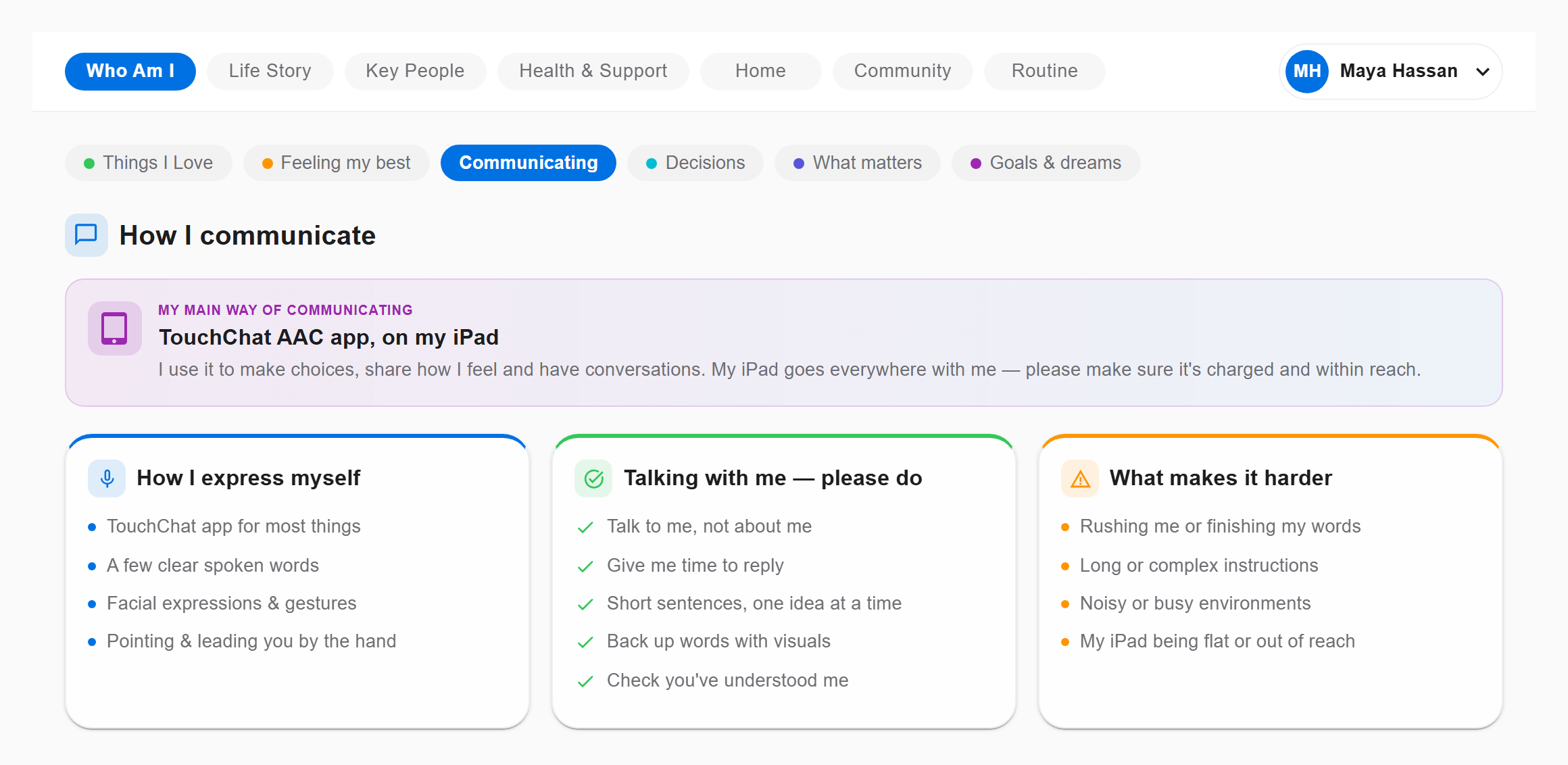
The kind of thing every new worker currently has to be told, written down once instead. Fabricated demo participant.
Right now, every service keeps its own separate file on the same person
The plan manager has one. The therapist has one. The agency has one. None of them talk to each other, and the person they're all about can't see inside any of them.
Re-explaining, every time
Every new worker starts from zero, and the person tells the same story about their life again, and again.
The history walks out the door
What a worker learned about supporting someone well sits in a system the person can't see — and leaves with them when they move on.
The admin eats the evening
Support workers finish a shift and start a second job: notes, invoices, agreements, receipts. Unpaid, and the first thing to slip.
Nobody measures the point
Hours delivered get counted carefully. Whether anyone's life is actually better rarely does.
The participant is the starting point, not a record in someone's system
An account of their own
The participant signs up, or their guardian holds it with them at whatever level of authority is right.
A profile builds up
Seven sections, from who they are to how their week is shaped, contributed by everyone who knows them.
They connect their team
Workers, therapists and providers. Connecting grants access to the profile; disconnecting removes it immediately.
The work flows back
Sessions, notes, invoices and outcomes attach back to their own account, visible to them as well as to the service that wrote them.
Two accounts, one shared profile
The participant's account is theirs, not a licence someone else holds. The tools workers and organisations use to run their business sit on top of it.
The participant decides who sees it
Access is theirs to grant and theirs to withdraw, at any time — connection by connection, not document by document. They see the invoices their workers send, their agreements, their goals and their progress, without asking anyone.
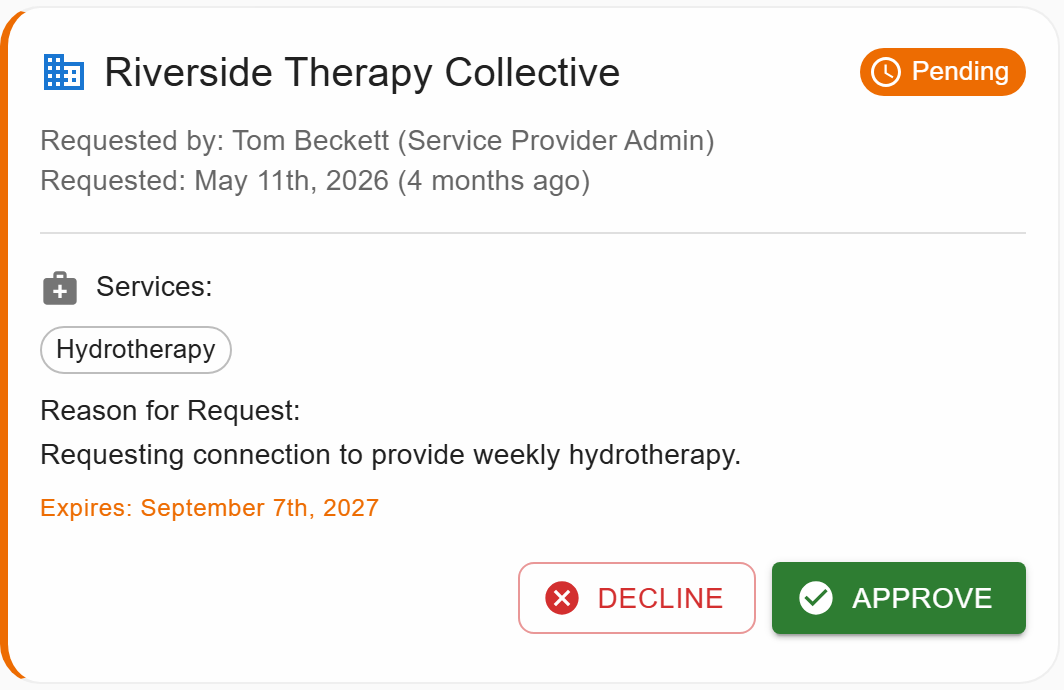
A provider asks. Nothing happens until the participant approves.
- A profile that saves re-explaining the same things
- Consent the participant controls, revocable at any time
- Guardians can hold the account with or beside them
- Every action on their behalf is permanently logged
The whole of the job, in one place
One place for the whole sequence — the profile before the first shift, the session logged, the note written, the invoice sent. For organisations with staff, the roster, the compliance checks and the pay run as well.
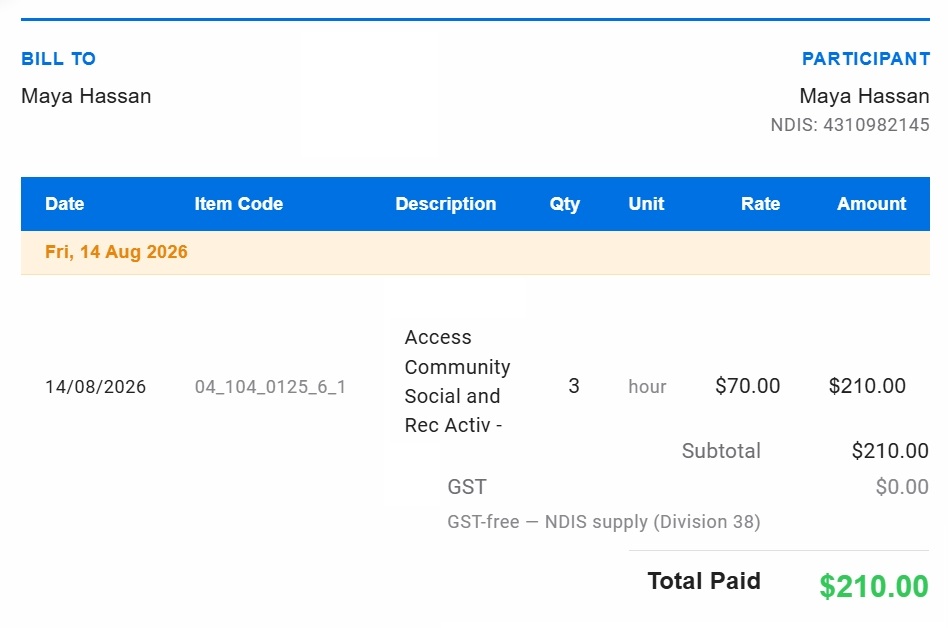
The last step of that sequence: the session logged, priced from the agreement, billed and paid. Fabricated demo participant.
- Agreements, sessions, invoices and expenses
- Case notes and reports, with AI to do the first draft
- Rostering, compliance, time & attendance and payroll
- Starts with sole traders, scales to organisations
Seven ways of knowing someone
Not a form. Seven sections, each shaped around what it's actually for — three about who the person is, one for the clinical planning, three for the life around them.
Who they are
The planning
The life around them
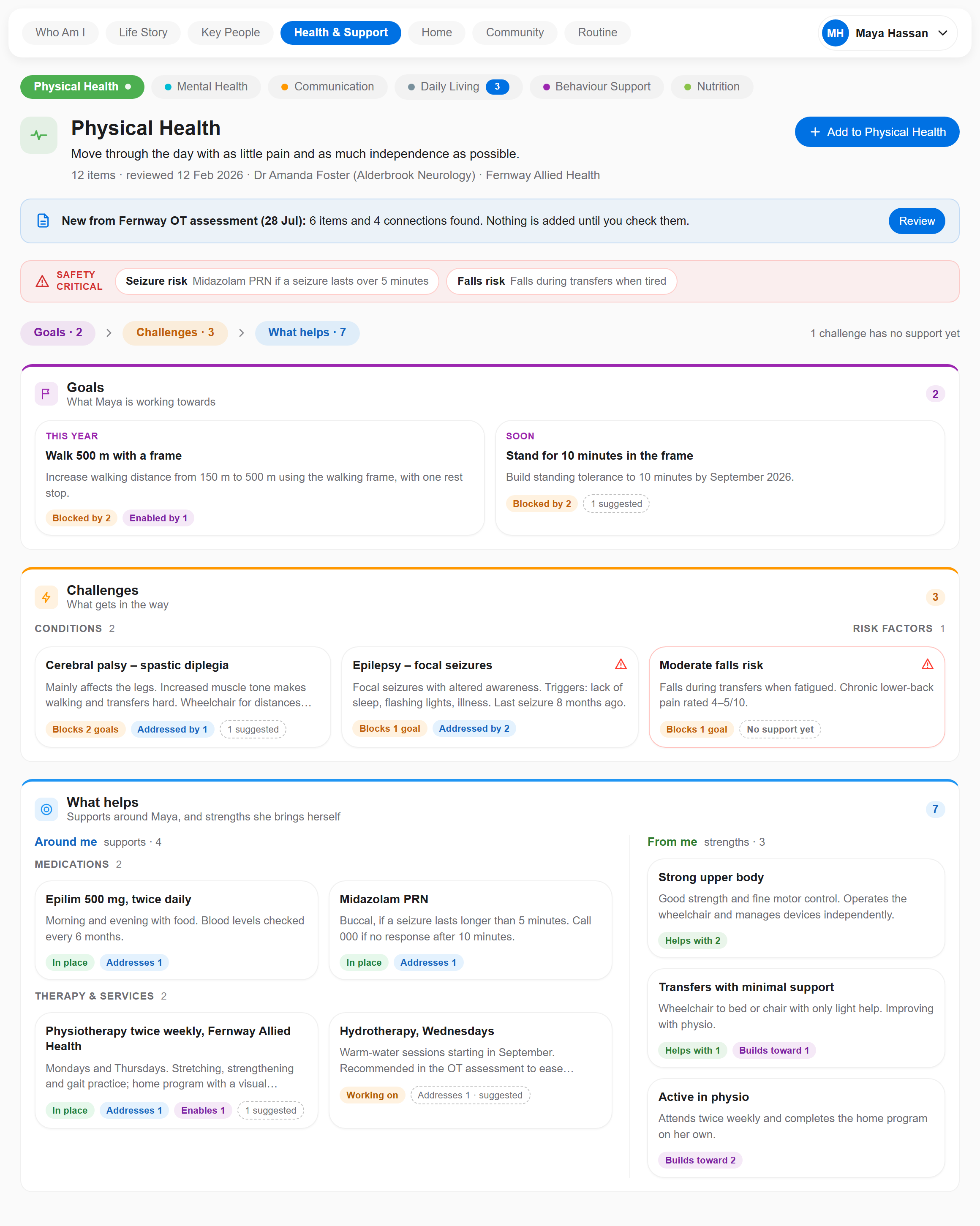
The clinical page in one view, and it reads in the order the thinking goes: what the person is working towards, then what's getting in the way, then what helps. Six health domains sit behind the switcher at the top, and nothing found in an uploaded assessment is added until someone checks it. Fabricated demo participant.
And what helps has two halves, held apart underneath.
What comes from the person sits beside what comes from around them — and underneath, the two are kept separate, for a reason that matters when the plan is written. How the profile works →
Built as one system
Profile, consent, sessions, invoicing, rostering and outcomes share one record, so nothing has to be re-entered or reconciled.
The participant profile
Seven sections, contributed to by the whole support team and readable by all of it.
Learn moreConnections & consent
Participants choose which providers have access. Disconnecting revokes it on the spot.
Learn moreSessions & invoicing
Agreements, session logs, travel and expenses, invoices out, reminders chased automatically.
Learn moreAI-assisted writing
First drafts of case notes and reports — from de-identified text, always reviewed by a human.
Learn moreRostering & payroll
Shifts, compliance, clock-in, timesheets and award-based pay for organisations with staff.
Learn moreQuality of Life
A structured, supervised assessment that measures whether life is actually getting better.
Learn moreNames come out before the AI sees anything
AI is genuinely useful for the writing work — first drafts of case notes, summaries, pulling structure out of a plan document. The personal details come out of the text before any model sees it, and go back afterwards. It's only used on a participant's information if they've agreed to it.
Judged without being seen
When a word can't be confidently recognised, the AI is asked whether it's a person's name — without being shown the word. It reasons from the surrounding sentence alone. The hardest call in the process is made by a model that structurally cannot see what it's deciding about.
One last check before it's sent
Just before anything goes to the AI, the text is checked against every name and detail already replaced. A stray copy is swapped for its placeholder, and if the text still can't be made clean, the request stops and nothing is sent.
It stays in Australia
Participant data is stored on AWS in Sydney, and AI calls run on AWS in Australia. There's no overseas AI service and no consumer AI tool anywhere in the path.
- Region
- SydneyParticipant data and every AI call stay in Australia.
- Architecture
- ServerlessNo servers of our own to patch or leave running.
- Auditing
- Write-onceGuardian actions archived where they can't be altered.
- Delivery
- Infrastructure as codeEvery resource version-controlled and reviewable.
Want to be part of the pilot?
We're looking for sole traders — support workers and practitioners — along with participants and families who'd like early access and are happy to tell us what's wrong with it.
Or write to hello@centre4ds.com — tell us whether you're a participant, a worker or a provider, and we'll be in touch.