
In development
The scheme funds supports. Almost nothing measures whether life got better.
Hours delivered are counted to the minute. Whether the person is happier, safer or more in control of their own week is usually an anecdote in a progress note, if it is recorded at all. This assessment exists to put a defensible answer under that question, and to track it over years.
Three pillars, twenty domains, seventy anchor points
The structure took a long time to settle, and the reason it has three levels is that each one answers a different question: what broad area of life, what part of it specifically, and what concrete thing can actually be observed and talked about.
Screened clearDeep-assessedConcern → deep-diveConcern → manual follow-upNot screenedSafety trackGate active
Self9 domains · 47 anchors
Body & Physical Function21
Emotional Experience3
Cognitive Function4
Identity & Inner Life3
Communication2
Relational Capacity3
Agency & Self-Determination3
Daily Living & Self-Management6
Engagement2
Environment6 domains · 12 anchors
Home3
Neighbourhood & Community2
Financial Resources1
Services & Systems3
Work, Learning & Opportunity2
Digital & Information1
Relationships5 domains · 11 anchors
Family3
Intimate Partnership2
Friendships & Social1
Support Workers & Professionals3
Community & Belonging2
Supervised, not self-serve
This isn't a wellbeing survey emailed to someone to fill in on their own. A practitioner sets it up, oversees it and reviews what comes back — the participant answers the parts that are theirs to answer.
A practitioner opens it
The assessment is created and overseen by a professional who knows the person and is accountable for what it produces.
The participant answers
Questions are answered in the app, in the participant's own account, with a response scale designed to be usable by people with cognitive disability.
Screening finds what matters
A domain screen flags where to look more closely. Flags, deliberately, not scores — it points at things worth a conversation.
The practitioner reviews
Results are read, checked and turned into something useful for planning. Nothing is treated as a verdict on someone's life without a person having looked at it.
Three different things, deliberately kept apart
Self-report and proxy-report are held as separate records and never merged. If a participant and the person speaking for them see it differently, that difference is the finding.
An outcome measure you can track
A stable, repeatable read on wellbeing across the twenty domains, taken the same way each time — so the number means something when you compare this year to last.
Goal attainment
Goals scaled from much-worse to much-better than expected, agreed in advance and scored later. It captures progress that matters to this specific person and would be invisible in any standardised measure.
A needs and support picture
Where the pressure is, what's already helping, and what's left over once existing supports are accounted for. This is the part that feeds planning — what to actually do on Monday.
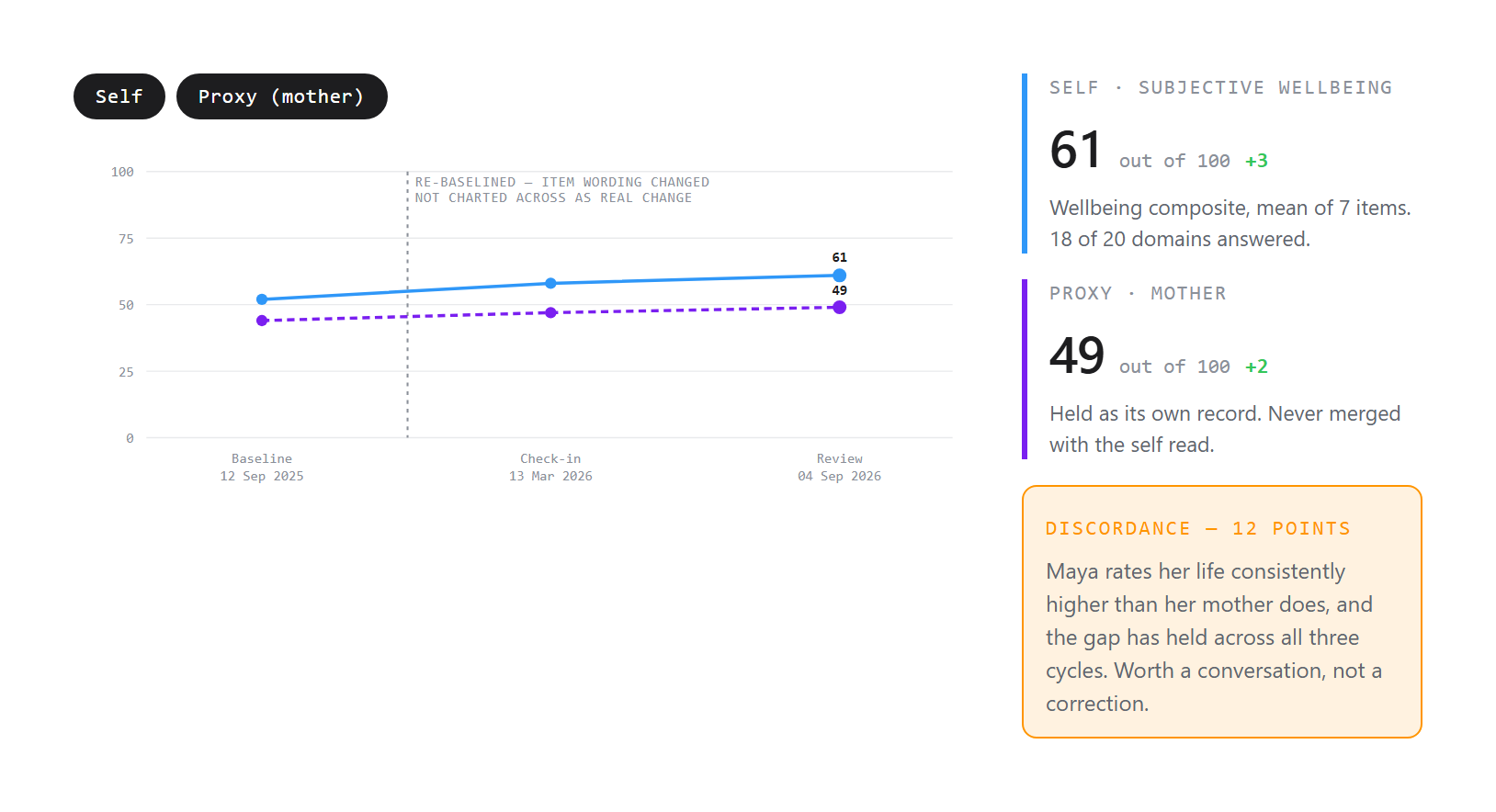
Self and proxy as two lines that are never averaged together, and a marker where the wording changed so a measurement artefact can't be read as progress. Illustrated with three cycles of demo data. Fabricated demo participant.
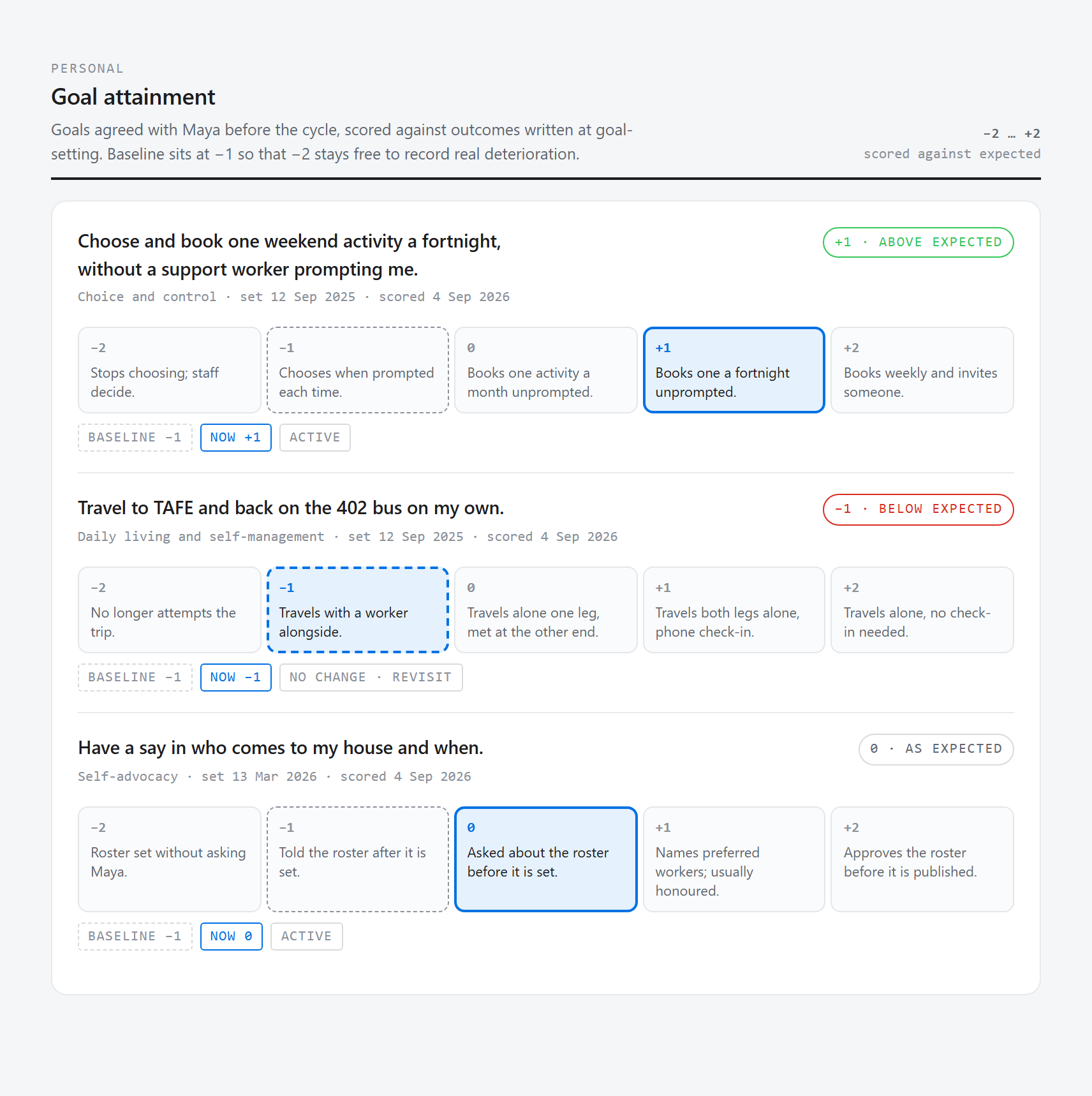
Goals written as five described outcomes before the cycle starts, then scored against what was agreed — including the one that didn't move. Fabricated demo participant.
Safety is a separate track, and it can't be averaged away
A person can be doing well across most of their life and still be in a situation that needs acting on this week. So safety concerns don't get folded into an overall score where a good average could hide them — they run on their own track, surface on their own, and a strong result elsewhere never suppresses them.
Built in development, and not yet road-tested
What's built
The taxonomy is settled and clinically reviewed. The pieces are built and wired in our development environment — documents in, evidence extracted against the seventy anchors, the scoring engine, and the answering surface a participant completes with a practitioner reviewing it.
They have been tested as code. Nobody has yet sat down and driven the whole thing through the screens, which is a different test and the one that finds what is really wrong.
What's still coming
The reporting layer those last three screens show — turning a series of assessments into a trend a participant, a family and a funder can all read. Feeding what the assessment learns back into the participant's profile automatically, so a fact captured here doesn't have to be typed again there. And the pilot itself, which is where the design meets real people and some of it turns out to be wrong.
If measuring outcomes is your problem too
We'd particularly like to hear from behaviour support practitioners, allied health professionals and support coordinators who've tried to evidence outcomes under the NDIS and want a better way to do it.