
In development
The support is the job. The rest shouldn't be.
Agreements, session logs, invoices, receipts, case notes. If you work for yourself, all of that lands on you after the shift is already over. CDS is built so the admin happens as you go, rather than at nine o'clock at night.
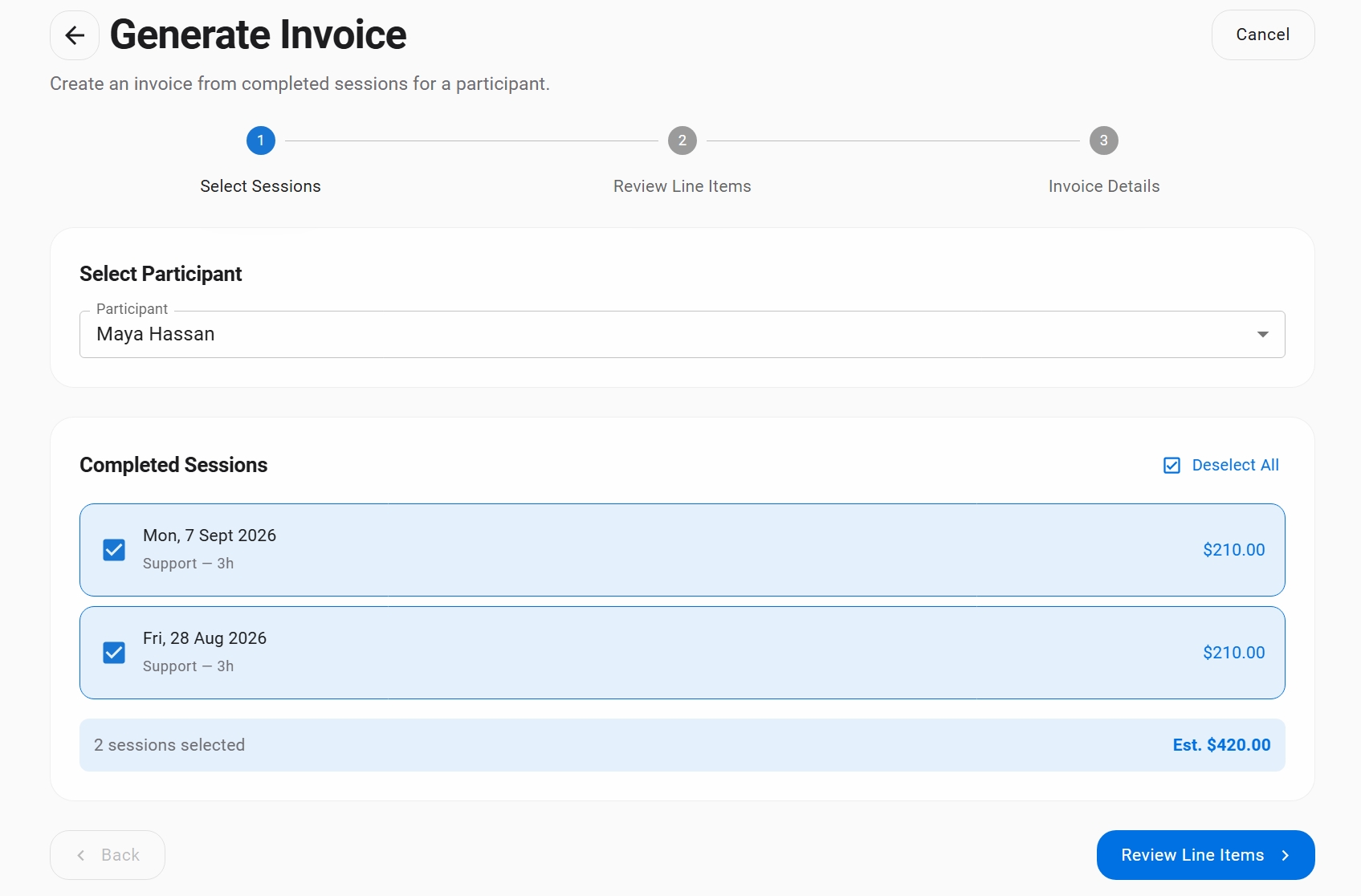
The shifts you already logged, priced from the agreement, ticked into an invoice. Fabricated demo participant.
A whole small business, not just a timesheet
Working as a sole trader under the NDIS means being your own scheduler, bookkeeper, contract manager and record keeper. These are the parts CDS takes on.
Before the work
Build the service agreement with your services, your rates and your travel terms. Sign it, send it, and the participant countersigns — signing dates recorded on both sides.
During
Log the session against that agreement while it's fresh. Travel and out-of-pocket costs get captured at the same time, receipts attached and kept.
After
Invoices are generated from the sessions you already logged, rendered to PDF, and chased automatically when they go overdue.
And the logging happens where you are
A session gets written up in the car between shifts, not at a desk at nine o'clock — the support item, the hours, what actually happened, and the travel leg with its kilometres. By the time you get home it is written, and it is already something you can invoice.
The same screens work on a laptop. They are just built so that the phone is not the poor relation.
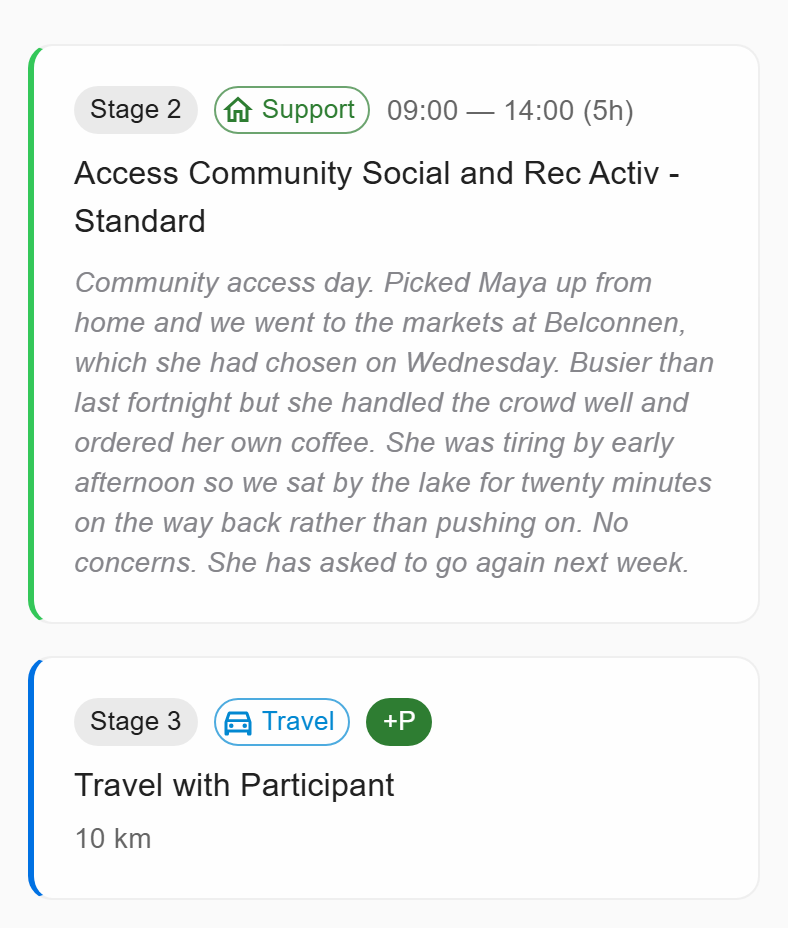
One session, written up on the phone. Fabricated demo participant.
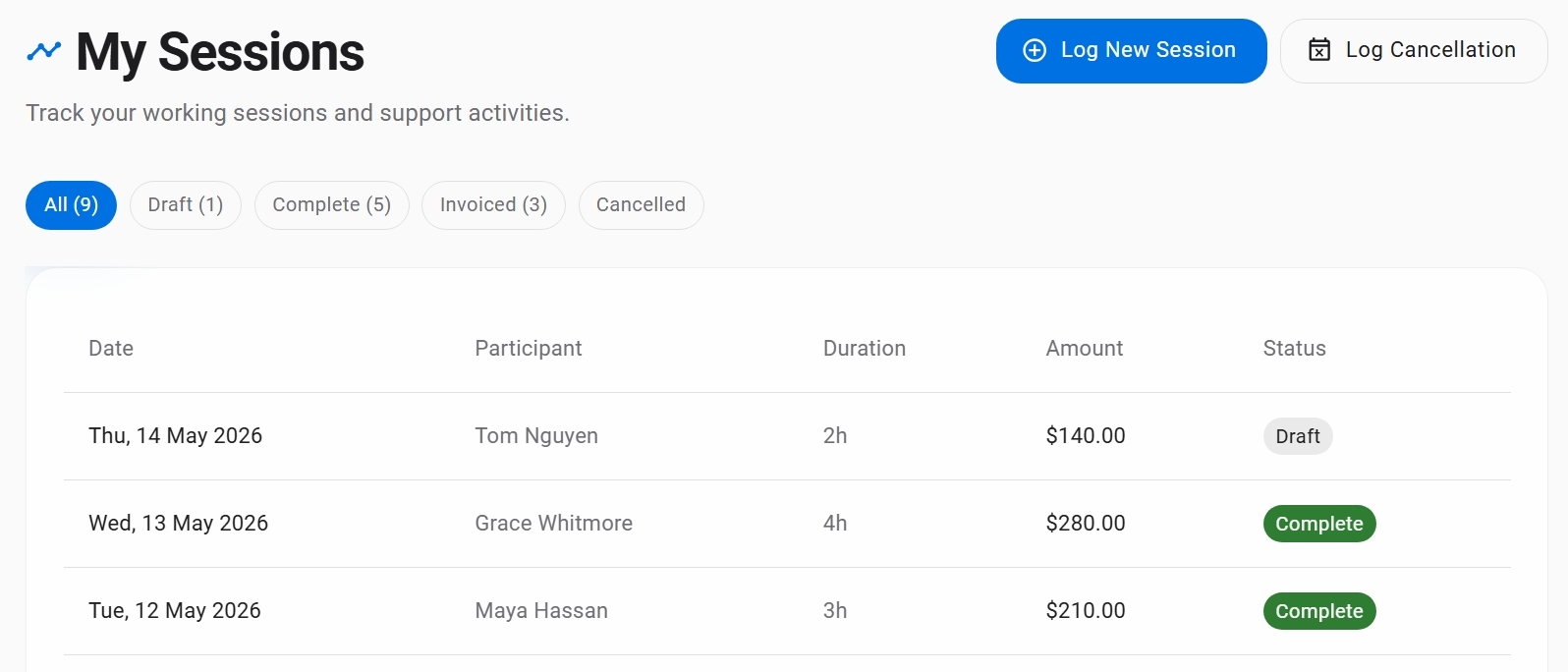
Each session with what it's worth and whether it's been invoiced yet. Fabricated demo participants.
Every invoice comes from an active agreement, so your billing and your contract can't quietly drift apart — which is the thing that goes wrong when the two live in different places.
And the rest of the paperwork
Case notes
Write the note against the participant, in the same place their profile lives, so the next person to open it gets the context and not just the sentence.
Incident reports
Structured reporting with photo attachments, so the hard days are documented properly rather than in a text message you'll never find again.
Quotes & pricing
NDIS support items and price limits are built in, including the codes that change by day type — so a Saturday doesn't get billed as a Tuesday.
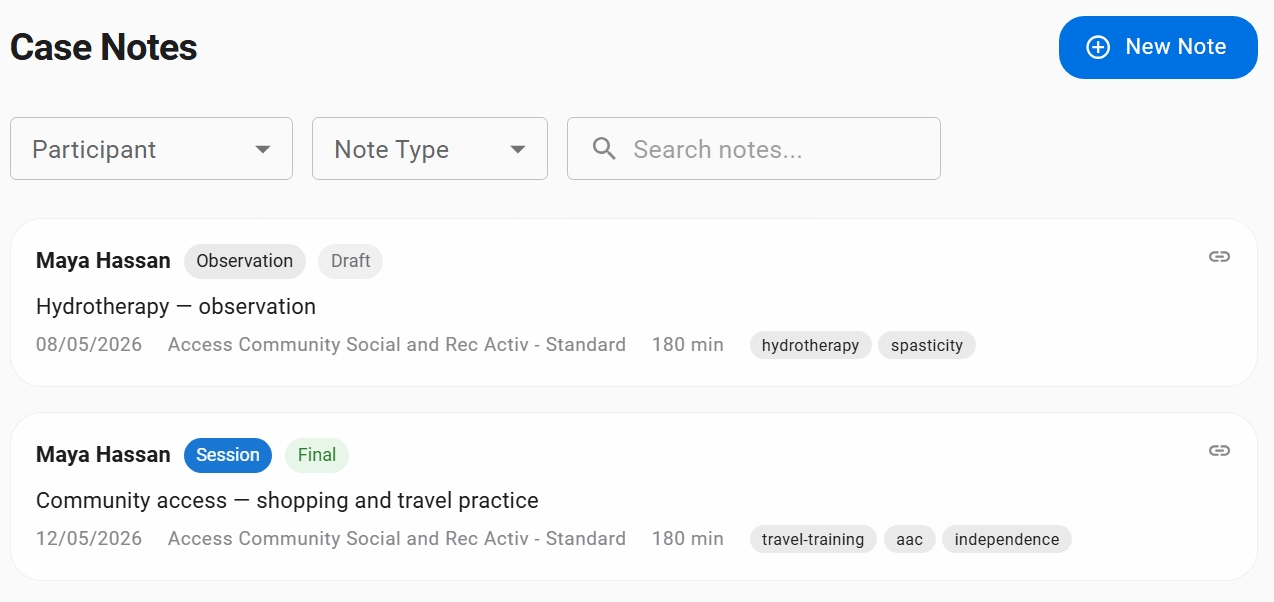
Notes filed against the participant and the support item, not a loose document. Fabricated demo participant.
A first draft, from the notes you'd write anyway
Type the rough version — the fragments you'd jot in the car. AI turns it into something you'd be comfortable having read back to you in a review, and you edit and approve it before it saves.
The part worth knowing: the names on the participant's record — theirs, yours, the organisation's — are replaced before the request is built, and restored afterwards, outside the AI boundary entirely.
- You always sign off — nothing saves on its own
- Writing by hand stays available and always works
- Participants decide whether AI can be used on their information
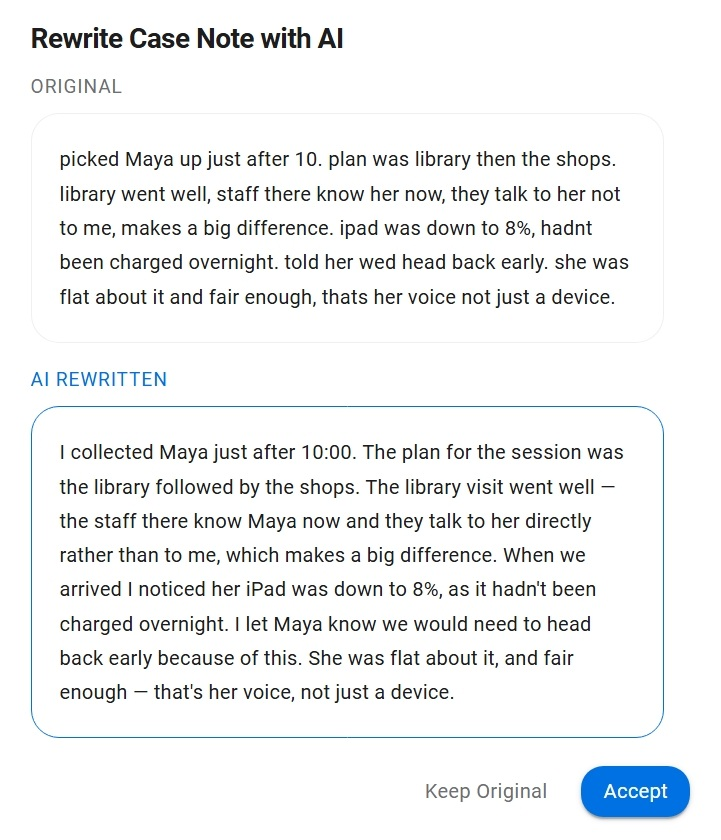
The rough note on top, the draft underneath — and the worker's own words survive the trip: "that's her voice, not just a device" comes back intact. Fabricated demo participant.
For behaviour support, speech pathology, OT and psychology
Allied health under the NDIS carries a documentation load that has very little to do with the clinical work and everything to do with being able to evidence it later.
Read the person before the first session
Connect to a participant and their profile is there — history, communication, what's been tried, what helps, what to avoid. Instead of an intake form and a guess, you start from what the people already supporting them know.
Behaviour support plans
Author plans in the platform against the participant's record, with the clinical history and the restrictive-practice reporting obligations in the same place rather than three systems apart.
Reports and clinical documentation
Draft reports with the same de-identified AI assistance, working from the record rather than from scratch — then edit and sign off as you would anything with your name on it.
Outcome measurement
Run the Quality of Life assessment under your oversight, so there's a defensible answer to "is this working?" beyond hours delivered. More about the assessment.
Because we're one
The support-worker side of CDS is the part we use ourselves every week — agreements with our own rates and travel terms, sessions logged against them with the receipts attached, invoices priced from the agreement and chased when they're late, notes written where the profile lives. It's the part that's furthest along, and the part we'd most like to put in front of people who aren't us.
Organisations get the same record with rostering, payroll and claiming on top. That comes after.